|
 |
|
 |
Don van Vliet Reviews
Written by Michael Amy;
Published in Art in America (July 1999)
Don Van Vliet achieved cult status as a composer, singer and horn-player, performing from the late-1960s to early-1980s under the nom d'artiste Captain Beefheart. In 1982, he abandoned rock music to devote himself exclusively to painting and drawing. A self-taught artist living and working in California, he has had a large number of exhibitions in Europe and the United States over the past 15 years.
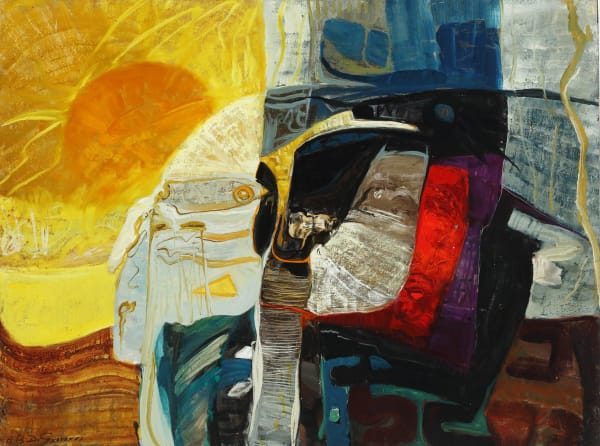
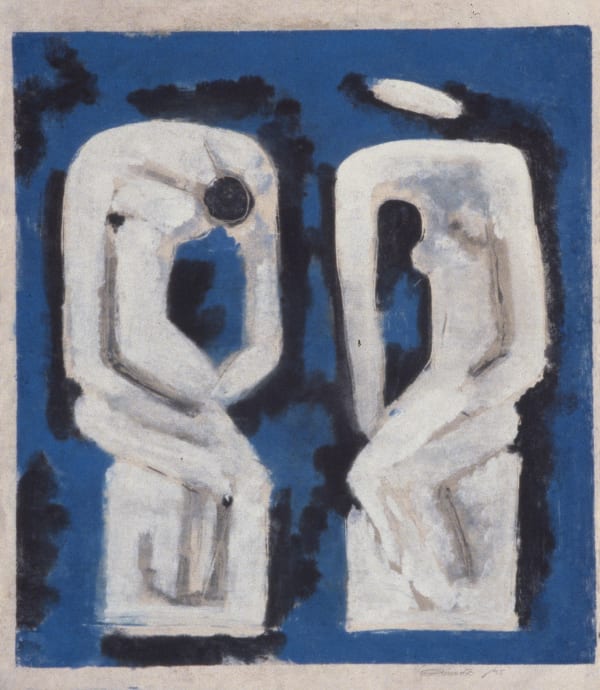
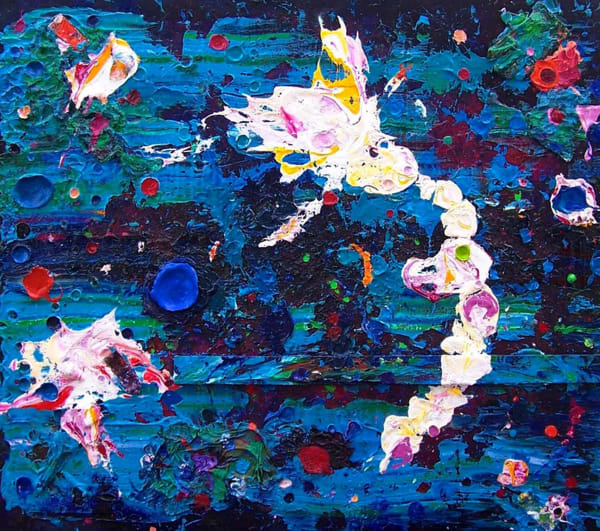
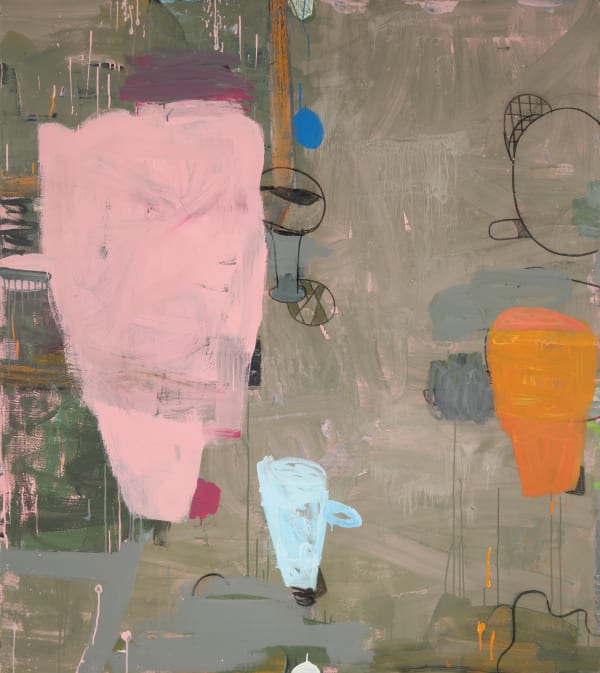
Van Vliet delves into his unconscious through improvised acts of drawing and painting which jumble figuration with considerable abstraction. His exhibition comprised medium-sized oil paintings on canvas and drawings on paper, as well as smaller sketchbook renderings. In his drawings, he seems perpetually intrigued by materials and is ready to juxtapose crayon, paint, pencil and water color on the same page.
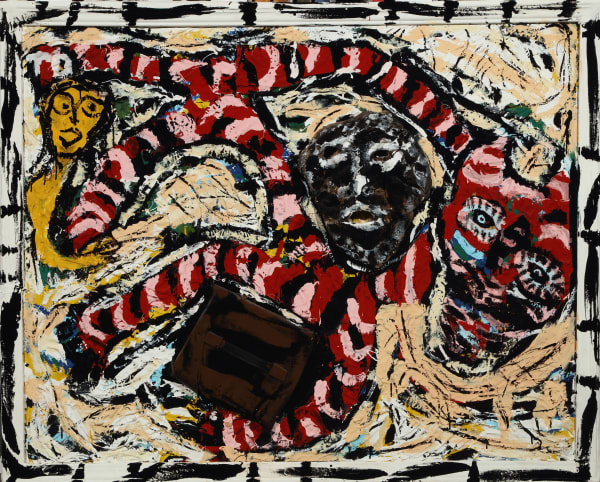
Drawn from nature and radically simplified or considerably abstracted, the motifs are generally shown in profile or front view, with little or no foreshortening. They are placed above one another and/or side by side in ambiguous spatial situations suggesting minimal depth. Prehistoric cave paintings and the art of children come to mind. The clumsy shapes are separated by expanses of white which offer necessary rest to the eye. This artist has a heavy-handed approach to painting, creating thick, meaty textures, occasionally rich in scumbling and sometimes including scratching with the handle of the brush. His style wavers between that of COBRA and 1980s Neo-Expressionism.
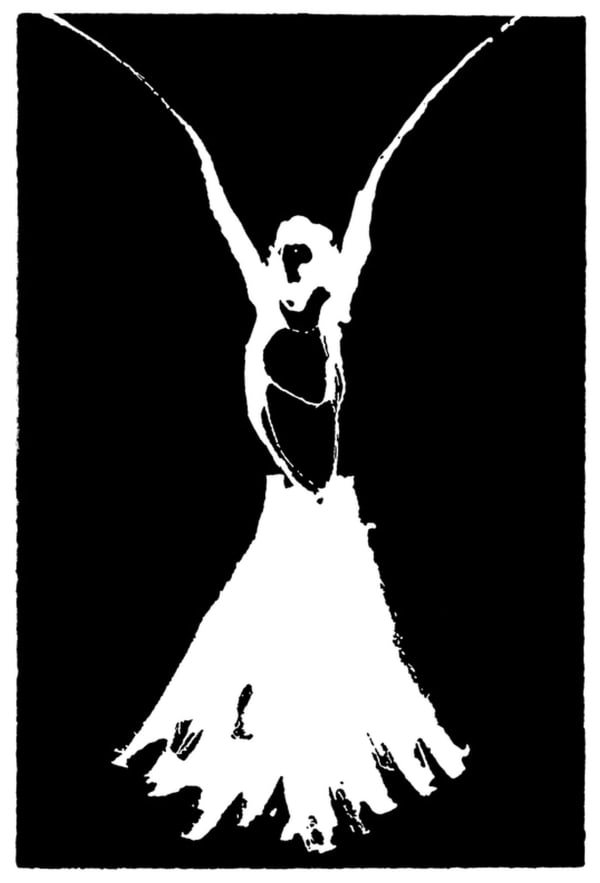
In Puce and Rouge (1997), among the most successful paintings in the exhibition, he develops the composition of the slightly smaller Ten Thousand Pistols, No Bumblebees (1995-96), which is likewise a vertical picture painted entirely in black and white. The pictographs appearing in these paintings obliquely recall those of A.R. Penck, an early champion of Van Vliet. These vivid pictures apparently show a hunter, with club raised high above his head, stalking an antelope with the skull of a horned animal hovering above them. Fragments of landscape appear along the top, bottom and right margins of the composition, and a small black-horned animal skull fills the top right corner.
In 1997-98, Van Vliet painted three pictures of the same size and vertical format, each named The Drazy Hoops and numbered one through three. These show a wild boar, seemingly pounced upon by a feline creature. A large geometric design consisting of black lines enclosing white voids looms above the animals. Several other paintings explore violence, while in other works sensuousness and lyricism come to the fore.
|
|
Written by Reagan Upshaw;
Published in Art in America (July 1995)
Let's say it straight out - Don Van Vliet is the famous underground musician Captain Beefheart. I wouldn't mention it, except that every press release, interview and book on his art does so, seemingly with the artist's blessing. It is also apparently impossible to write about him without mentioning his high school buddy Frank Zappa, so let's get that out of the way as well. But in addition to his music, Van Vliet has been making art for the past 30 years or so and has been exhibiting in New York for the past 10. His recent exhibition brought together 10 works from the past three years.
Van Vliet presents himself as the child prodigy, later wild man from the boondocks, who comes to his work naturally. "When I'm doing a bad painting," he told an interviewer, "I've been thinking too much." That could be a credo for the romantic: don't think, just feel. Take a drink or toke and let 'er rip. I find it hard, however, to believe that Van Vliet hasn't looked closely at Abstract Expressionism, in particular Franz Kline and Philip Guston.
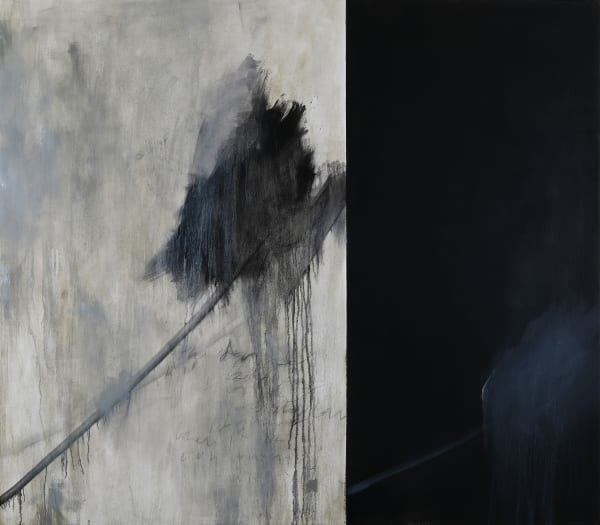
In the new works, a white-painted area serves as the background against which loose forms swirl and sometimes coalesce into recognizable, almost totemic figures: Abstract Expressionism reverting to the cave paintings at Lascaux. As other times, the forms resemble cryptic pictograms. All of this is done in delicious brushwork, the impasto of the figures competing for primacy with the impasto of the white area, creating a constant back-and-forth between perceived background and foreground and the actual white area and figures which are of equal thickness.
It is difficult to find standards to judge an art such as Van Vliet's. The artist would probably say that as long as the paintings come from the id, unconstrained by conscious thought, they are valid. Indeed, some of his works, such as God's Empty Socks, Paris Cow and High Black Shadows have an undeniable power.
|
|
 |
 |
 |
 |
|
 |
DonVanVliet:
The Automatic Method
INTRODUCTION:
The latter half of the twentieth century has produced its share of
capable artists but it has produced only a few who could truly be
called visionary. Don Van Vliet, (pronounced Van Vliet) would have
to be on this short list. Beginning in the mid-sixties, as the
madman/poet/singer/composer known as "Captain Beefheart," he
championed avant-garde music with his eccentric fusion of influences
and innovative compositions for the next two decades. Then,
inexplicably, at the zenith of his career, he stopped making music
and began to pursue painting full lime.
CHANGING MEDIUMS:
His music fans were, of course, heartbroken. Even though they had
known he was a self-taught painter all along - many of his best
album covers were created by Van Vliet - they never imagined such a
complete change of medium. They were also, rightfully, afraid for
their hero because the art world is fraught with former athletes,
rock stars, or actors who have taken up painting in the hopes of
cashing in on their notability. This was not, however, to be the
case with Van Vliet because, unbeknownst to his fans, he was
considered a visual arts prodigy long before his fame as a musician.
HISTORY:
As a child, Van Vliet was proclaimed a major talent by the
celebrated Portuguese sculptor Augustinio Rodriguez who had
discovered him sculpting at Los Angeles's Griffith Park Zoo and had
then helped to secure him a television spot sculpting "images of
nature." By the age of thirteen Van Vliet had won a scholarship to
study art in Europe but his parents, believing that art was not a
manly pursuit, thwarted his efforts. In the hopes of finding
non-artistic environs his father moved the family to the desert.
This move was to have a profound influence on the aspiring artist.
To this date Van Vliet's art, regardless of medium, contains images
of the desert. His one and only period of "self-exile" was to the
desert. Clearly, the figure/ground relationships in his current
canvases, the large white open passages punctuated with sparse
figures, point to the importance of this arid and austere landscape
in his life.
PROCESS:
Van Vliet first applies a thick impasto of white paint to the entire
surface of the canvas to establish a primordial pool for his
phenomena to float upon. Then, like an early cave-dweller
discovering the magic of representation he begins the exploratory
mark-making. He scrawls and scribbles and scratches and blocks in
areas of organic shapes until his mind's eye makes the animistic
associations he seeks. Some of his gestural lines will birth into
creatures, others will remain the detritus of the creative process.
Van Vliet does not conceal his discards but rather he simply moves
onto another area of the canvas to resume the linear exploration. He
performs a fast execution in order to keep it fresh and to prevent
the painterly passages from bogging down in too much conscious
thought.
METHODOLOGY:
Although Van Vliet's domain of constantly metamorphosing forms runs
the gamut from representationalism to abstraction, his modus
operandi is essentially a matter of Automatism. This Surrealist
technique of closing one's eyes and letting the hand draw without
the aid of conscious direction, creates a state of self-hypnosis, "a
stream of consciousness," where associative images float up to the
surface from the subconscious depths. During this part of his
process Van Vliet is a passive receptor, a conduit for the receipt
of information from that other world. With his feverish recording of
these floating images the artist is thus able to form new
expressions through the associative process.
IMAGERY:
What's to be said of these floating animal-like forms? Are they
templates of organic design? Are they primary forms, rough sketches
of theoretical beings discarded onto the floor by the great creator?
Perhaps they are visages of the prey we stalked for countless
thousands of years, now permanently imprinted within primal memory.
Even though we consciously have no idea what they actually mean, we
find ourselves watching them because the subconscious does know from
whence they came. We daily provide the consciousness with various
forms of entertainment. It could be said that the paintings of Don
Van Vliet are entertainment for the subconscious.
CLOSING:
True to the credo of the Renaissance man. Van Vliet states that,
"Talking about different art-forms is like counting raindrops: there
are rivers and streams and oceans, but it's all the same substance."
From the beginning it was obvious that this artist is full of the
raw materials that make great art: he is a bottomless reservoir of
subject matter, he pushes creative boundaries to capture and record
the strange phenomena from his subconscious, he is utterly
innovative with material usage. After a lifetime of experimenting
with different mediums it now appears that Don Van Vliet has finally
found the ideal voice. |
|